
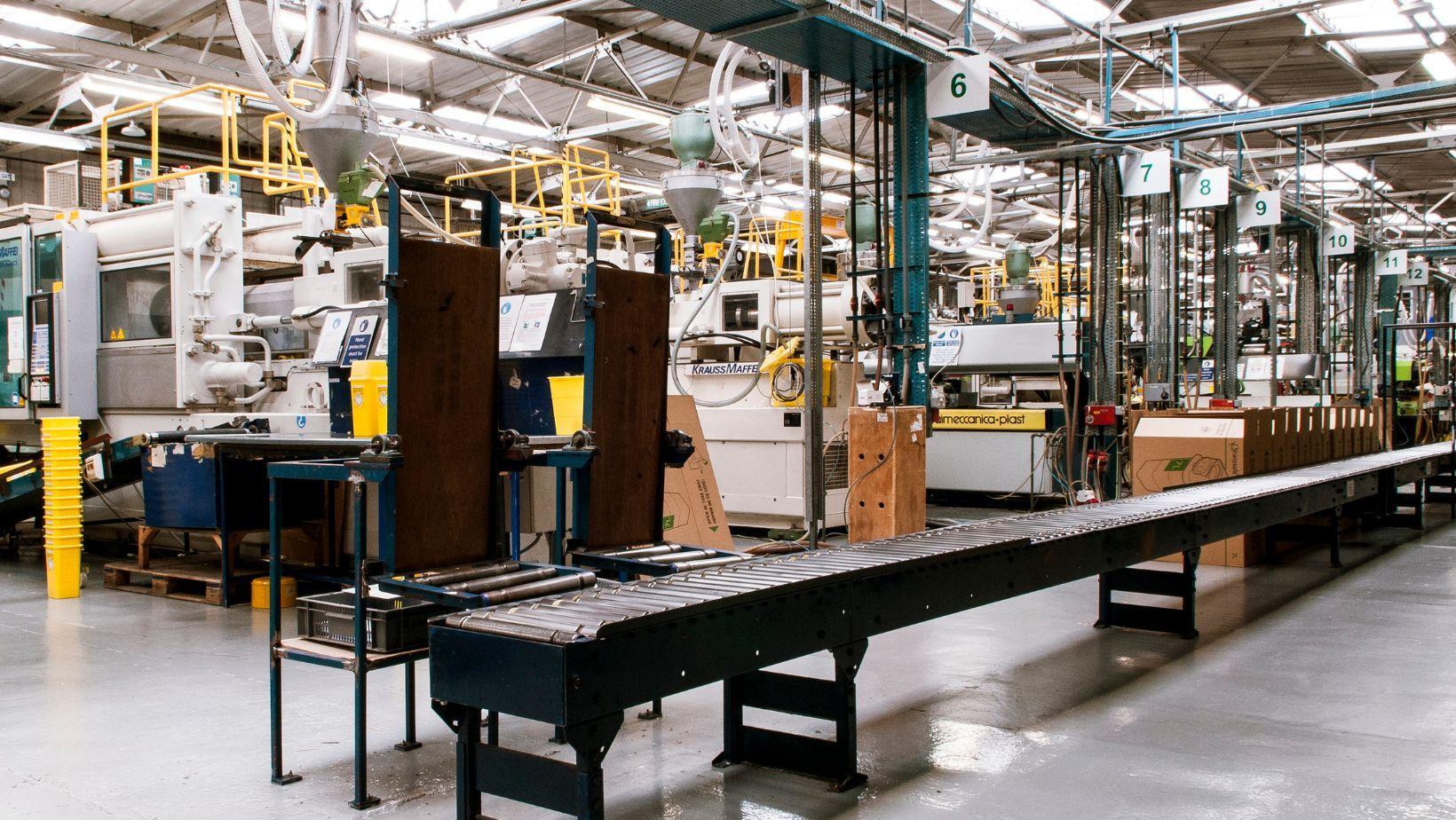
Picture a factory floor at full speed. Bottles march by like soldiers on parade, smartphones glide past on conveyor belts, and chocolate bars roll toward their packaging. Somewhere above each line, a camera sits quietly watching every unit. The AI model gets the press attention. The camera gets the budget line. The lens, that small piece of glass and metal bolted to the front of the camera, decides whether the whole system actually works. In modern factories it has quietly become one of the most important purchases in the building, and most people running production have no idea.
What this little piece of glass actually does
An industrial vision lens is not a fancier version of the lens on a smartphone. It is a precision-engineered optical assembly built for one job: turning whatever passes under a camera into a sharp, repeatable image that a computer can read. Consumer lenses chase pretty bokeh and forgiving autofocus. An industrial lens chases predictability under brutal conditions: thousands of frames per hour, constant vibration, varying ambient light, and parts that have to be measured the same way every time.
That is why specifying a dedicated machine vision lens for production is the single most important call in any inspection project. Get this part wrong, and the camera captures blurry edges, distorted corners, and shifting colour. Get it right, and a humble camera plus a basic algorithm can detect defects below a hundred microns, every second, every shift, for years. The fixture is small. The leverage on quality is enormous.
How the optics actually work
A handful of specifications decide whether a lens fits a job.
Focal length is the obvious one. It sets how wide a slice of the conveyor the camera sees. Short focal length, wide view. Long focal length, narrow zoom from further away.
Aperture, written as an F-number, controls how much light gets through and how deep the in-focus zone is. F1.4 is bright and shallow. F8 is dimmer and sharp across depth.
Image circle tells you which sensor sizes the lens supports. A one-inch lens fitted to a larger 1.1-inch sensor leaves dark corners and wasted pixels.
Resolution is measured in line pairs per millimetre. A lens that supports a 25-megapixel sensor in the centre but drops off at the edges silently caps the entire system. Whatever an AI model can be trained to spot is bounded by what the lens actually delivers to the sensor.
Where production lines depend on the lens
The applications are everywhere once you start looking.
- Electronics assembly, where circuit boards roll under cameras and solder joints get checked at micron resolution before the board has cooled.
- Food and beverage lines, where bottle fill levels, cap seals, and label placement are confirmed at hundreds of units a minute.
- Pharmaceutical packaging, where every blister pack is photographed for tamper evidence and every printed batch number is verified against the manufacturing record.
- Automotive parts production, where weld seams and gasket dimensions are measured with sub-millimetre accuracy.
- Plastics recycling, where shortwave infrared light combined with high-resolution optics separates polymer types that look identical to the human eye.
- Logistics centres, where barcodes and DMC codes are read at varying distances on parcels that can be skewed, smudged, or scratched.
- Pick-and-place robotics, where the lens tells the robot what shape it is grabbing and exactly where to grab it.
Each of these settings could swap out the camera body or the AI model and still work. Take out the lens, and the rest of the stack is staring into a fog.
Why production quality lives and dies on the lens
Smart factories sound like a software story. They are mostly a hardware story dressed up in software language. The brilliance of a neural network depends on what it is fed, and what it is fed is a stream of pixels. If those pixels are noisy, distorted, or out of focus, the model has nothing real to work with. Re-training cannot recover detail that the lens never captured in the first place.
This is the part that frustrates production managers who have invested in expensive cameras and stalled at flat accuracy curves. The lens is often the culprit hiding in plain sight. Pixels can look clean at first glance, but a closer look reveals soft edges or geometric distortion that fools the algorithm in subtle ways.
The same logic applies as factories link cameras into wider IoT and analytics platforms. Lens quality is upstream of every metric reported downstream. Spend money on cloud dashboards before spending it on a competent optical front end, and the dashboards display confidently wrong numbers.
Choosing the right one without getting lost
A short checklist gets to the right lens faster than any vendor brochure.
- Decide the smallest feature the system must detect, and at what distance. That defines the focal length and minimum resolution. A lens that cannot resolve the required line pairs per millimetre is out before any model is even trained.
- Match the lens mount and image circle to the camera sensor. Most industrial lenses use C-mount or M12 mounts, and the image circle has to cover the sensor or corners go dark.
- Decide how fixed the setup is. Stable lines with a constant working distance work best with fixed-focal lenses, which are sharper and more affordable. Variable distances need varifocal or autofocus optics.
Reputable lens suppliers offer a simple online calculator that takes sensor size, field of view, and working distance and produces a recommended focal length. That cuts hours of guesswork to seconds.
The bigger picture
Modern manufacturing is increasingly an exercise in seeing. The factories that win the next decade will be the ones whose machines see most clearly. Cameras keep getting better. AI models keep getting smarter. The lens is the part that does not get rebuilt with every software update. Choose it well at the start, and every other component in the vision stack gets to perform at its best. Treat it as a checkbox at the bottom of the bill of materials, and no amount of clever software will compensate for what was never seen in the first place.

Bianca Johnson’s story begins with a strong enthusiasm for writing and motherhood. This passion drove her to launch the blog, Conversations with Bianca. Its purpose is to aid mothers in tackling their daily struggles. Bianca’s personal experiences, along with her love for raising children, inspired her to build a supportive community for parents.
As a mom of two, Bianca knows how hard parenting can be. On her blog, she gives advice on how to combine work and family duties with ease. The hope is that parents can find ways to manage their lives correctly, and still have time to enjoy raising their children. Conversations with Bianca aims to assist modern moms in preserving their autonomy while taking care of their families.