
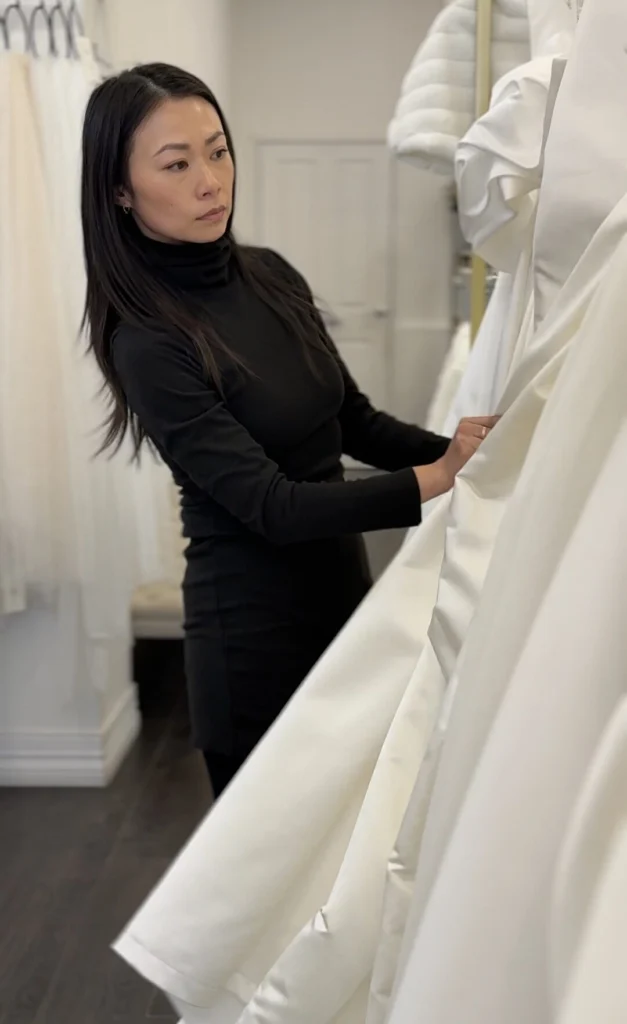
Most of the nerves around a first bridal appointment have nothing to do with the dresses themselves. It’s not knowing what actually happens once you walk in. Do you need to bring photos? Will someone judge your budget out loud? Is there really champagne, or is that just something people say? None of it is complicated once you’ve done it once, but nobody explains it beforehand, so here’s what an appointment at a proper boutique actually looks like, start to finish, from the first phone call to the moment you’re back in your regular clothes wondering what just happened.
1. What Happens Before You Even Walk In
A good boutique doesn’t just book you a time slot and leave the rest to chance. Most will call or email beforehand to ask about your wedding date, your general style, your budget range, and sometimes a few photos of dresses you like or dislike. That information gets used to pull a starting selection before you arrive, so your first fitting isn’t just wandering a rack cold.
This step matters more than brides usually expect. It means your first fifteen minutes in store are spent trying things on rather than explaining your taste from scratch to someone meeting you for the first time. It also gives the boutique a chance to flag early if your budget and your style references don’t quite line up, so nobody’s surprised by that conversation once you’re already standing in a gown.
2. The Room Itself Is Not What You’re Picturing
If your only reference point is a big department store, the actual setting can be a genuine surprise. A bridal boutique melbourne brides visit for a private appointment usually books one bride at a time, or close to it, in a room that’s just for you and whoever you’ve brought along. No shared racks, no other brides crying in the next curtain, no waiting your turn for a mirror.
That privacy changes how you actually react to gowns. Most people don’t cry, laugh, or go quiet on cue in front of strangers, so a private room tends to get you closer to your honest reaction than a crowded one ever will.
3. What Your Consultant Is Actually Doing While You’re Trying Things On
This part happens mostly out of view. A good consultant is watching how you stand, how you move, which necklines you keep touching self-consciously, and which ones you forget about within thirty seconds. They’re reading your reactions almost as closely as you’re reading the mirror.
That’s also why the gowns tend to shift partway through the appointment. If you came in asking for lace and keep gravitating toward the plainest dress on the rack, a good consultant will notice and start pulling more of that instead, even if it wasn’t the plan going in. This is also the point where they’ll usually ask questions out loud, about how the fabric feels, whether the neckline feels right, whether you’d want more or less coverage, rather than just watching silently and guessing.
4. You’ll Try On Fewer Dresses Than You Expect, and That’s Deliberate
A common assumption is that more options equal a better appointment. In practice, five or six well-chosen gowns usually beats fifteen random ones, because by dress number ten most brides can’t remember what dress number three actually looked or felt like. Quality of selection matters more than quantity.
If you walk in with a long wishlist and your consultant gently narrows it, that’s not them limiting you. It’s usually them protecting you from decision fatigue setting in halfway through the appointment. By the time most brides reach gown eight or nine, they start describing every dress as “nice” instead of forming any real opinion, which is a sign the appointment has gone on a little too long.
5. What Happens If You Say Yes, and What Happens If You Don’t
Saying yes on the day isn’t required, and a good boutique won’t pressure you into it. If you do find the one, the next steps are usually measurements, a deposit, and an order placed with the designer, followed by a rough timeline for when fittings will start.
If you don’t say yes, that’s a completely normal outcome too, especially on a first appointment. Most consultants would rather you come back certain than commit out of pressure in the room. A follow-up call a few days later, once the excitement’s settled, is usually part of the process either way, and it’s a genuinely useful check-in rather than a sales tactic, since it often reveals whether a dress is still on your mind once the appointment adrenaline has worn off.
6. What to Actually Bring, and What to Leave at Home
Bring the right underwear, something close to what you’ll wear on the day, and comfortable flexibility around the shoes since heel height changes how a gown sits. Bring one or two people whose opinions you actually trust, not a full guest list.
Leave your phone mostly in your bag rather than photographing every single gown, since it tends to pull you out of the moment and into judging photos instead of trusting how the dress actually feels on your body in real time. A quick photo at the very end of a shortlisted gown is fine, but scrolling through ten blurry mirror shots later rarely tells you anything the appointment itself didn’t already.
The Simple Version
A boutique appointment is less mysterious once you know the shape of it. There’s a bit of preparation before you arrive, a private space designed to get an honest reaction out of you, a consultant paying more attention than you might realise, and no pressure to decide before you’re ready. Walk in expecting a conversation rather than a performance, and the whole thing gets a lot less intimidating.

Bianca Johnson’s story begins with a strong enthusiasm for writing and motherhood. This passion drove her to launch the blog, Conversations with Bianca. Its purpose is to aid mothers in tackling their daily struggles. Bianca’s personal experiences, along with her love for raising children, inspired her to build a supportive community for parents.
As a mom of two, Bianca knows how hard parenting can be. On her blog, she gives advice on how to combine work and family duties with ease. The hope is that parents can find ways to manage their lives correctly, and still have time to enjoy raising their children. Conversations with Bianca aims to assist modern moms in preserving their autonomy while taking care of their families.