
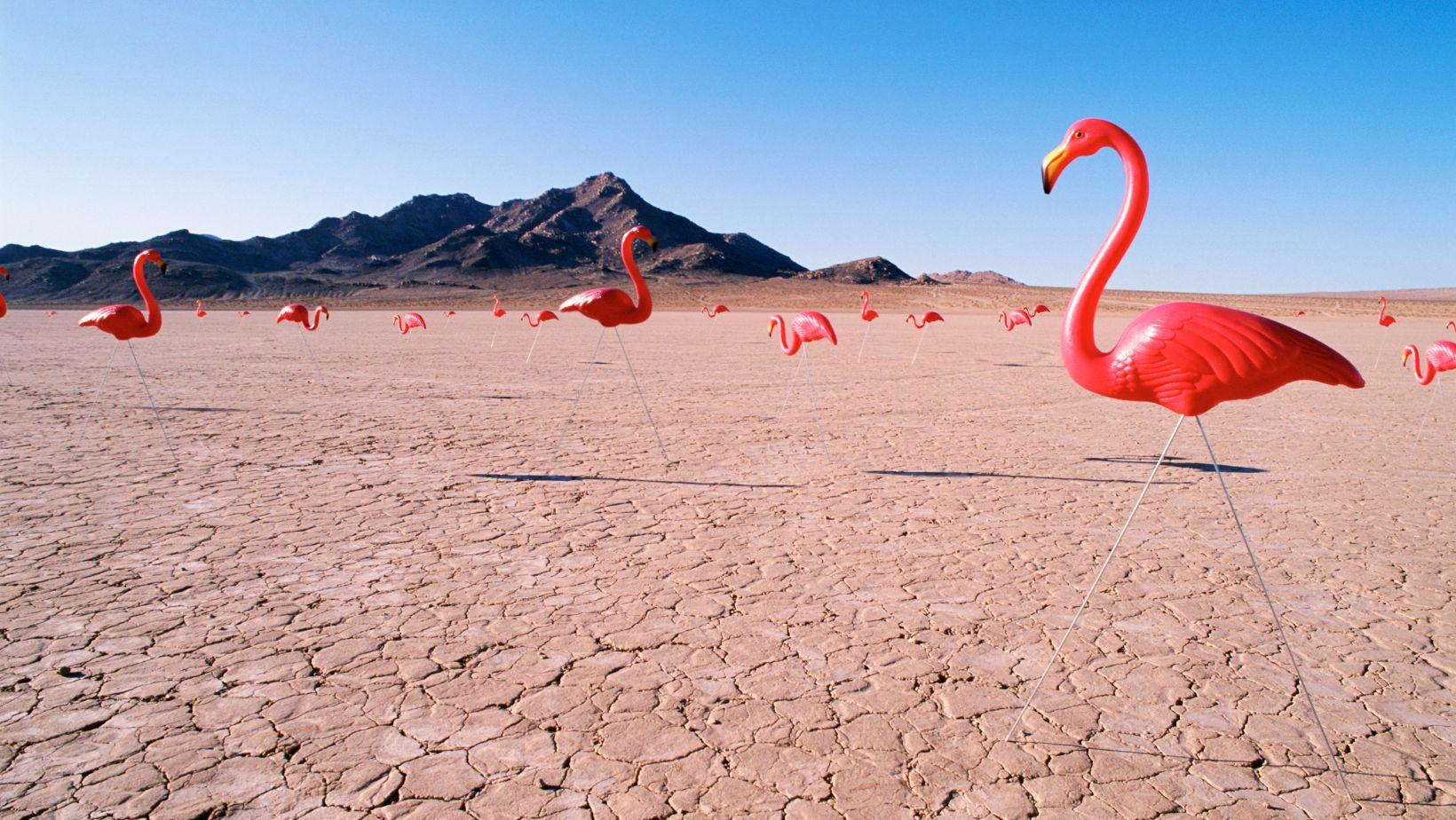
On a suburban lawn in Leominster, Massachusetts, in 1957, a young art school graduate named Don Featherstone sculpted a bird that would outlive most of the houses it decorated. His creation, a hollow polyethylene flamingo with wire legs and a painted black beak tip, cost about $2.76 for a pair when Union Products first shipped it. Nearly seven decades later, plastic flamingos are one of the most recognizable pieces of American yard decor, sold by the millions and argued over by design critics who cannot decide whether they are folk art, kitsch, or a national inside joke that got out of hand.
Novelty items sold constantly in the late 1950s, so the initial success is not the interesting part. The interesting part is that the flamingo refused to leave. Every attempt to bury it, whether through parody, gentrification, or the shutdown of Union Products itself in 2006, has failed, and a rival manufacturer bought the original molds within a year of the closure. Jennifer Price, the cultural historian who wrote the definitive essay on the bird in her 1999 book Flight Maps, argued that the flamingo’s tackiness was always the point, and that people who sneered at it were mostly sneering at the class of people who bought it. Nearly thirty years later that reading holds up better than most academic pronouncements about lawn ornaments.
A short history of a pink bird
Featherstone modeled the original flamingo from a photograph in National Geographic, since Union Products could not afford to fly him to Florida. He sculpted two poses, one with the head up and alert, one with the head down as if feeding, and the alert pose became the icon. In its earliest years, the flamingo signaled aspiration. A homeowner with a flamingo had access to warmth, leisure, Miami, the idea of a vacation without actually taking one. Postwar suburbanites bought them for the same reason they bought tiki mugs and rattan bar carts. The bird was a passport stamp for people who had never left Ohio.
By the 1970s the meaning had flipped. John Waters cast the flamingo as shorthand for trashy Americana in his 1972 film Pink Flamingos, and the bird became a punchline. Suburban taste-makers pulled them off lawns. College students stole them for pranks and left them on rival fraternity porches. The ironic phase turned out to be more durable than the sincere phase, which is often how these things go.
The University of Wisconsin-Madison adopted the plastic flamingo as its official bird in 2009, referencing a 1979 stunt in which the student body president planted 1,008 of them on Bascom Hill. Featherstone himself received the Ig Nobel Prize in 1996, an award he accepted while wearing a suit his wife Nancy had made to match one of hers, as he did every day for decades. He died in 2015. Union Products’ molds are now owned by Cado Products in Fitchburg, Massachusetts, and the birds are still stamped with his signature under the tail, which feels like the kind of detail Featherstone would have insisted on.
Why the design actually works
Set aside the cultural baggage and the object itself is quietly well engineered. The hollow blow-molded body weighs almost nothing, which matters when a lawn ornament has to survive a New England winter or a Gulf Coast squall. The wire legs flex rather than snap. Featherstone calculated the sight angle so that the head reads as a head from a passing car, not as an abstract pink blob, and cheaper knockoffs from discount bins always look slightly wrong even when the buyer cannot say why. The proportions are the reason.
The color holds up too. Original Union Products flamingos used a specific pink pigment that fades gracefully rather than chalking or yellowing, while cheaper competitors turned salmon within a season. Collectors on eBay will pay $40 to $80 for a verified pre-2006 pair in decent condition, which is roughly fifteen times the original retail price adjusted for inflation. A garden center manager in Vermont told the Boston Globe in 2018 that she still gets calls asking specifically for the Featherstone version, which she takes as evidence that the audience is paying attention even when the industry assumes it is not.
The novelty accessories economy around them
The flamingo did not stay alone on the lawn for long. It became the anchor of an entire novelty decor category that now includes inflatable pool versions, string lights shaped like the bird, shower curtains, coasters, and a surprising volume of drinkware. Search any online marketplace and the results spill outward into an ecosystem of adjacent kitsch: glitter booze flasks disguised as sunscreen bottles, lighter wraps printed with tropical motifs, novelty amazon spectacle frames shaped like palm trees or martini glasses. The visual grammar tends to be pink, teal, coral, and chrome, anything that suggests a poolside without requiring one.
This matters for anyone thinking about outdoor styling as a coherent project rather than a pile of individual purchases. A yard with three flamingos, a set of tiki torches, and a rattan lounger reads as intentional. The same yard with one flamingo and a random gnome reads as accidental, or worse, as ironic in the tired way. Commitment is what separates the two.
Eyewear followed the same arc. What started as cheap plastic novelty shades at beach town gift shops turned into a legitimate design category, with brands treating summer frames as seasonal fashion rather than disposable throwaways. Runners and cyclists began wearing colored polarized frames on the trail, then off the trail, then to brunch. A pair of Goodr stylish sunglasses sitting next to a flamingo-print towel now reads as a complete visual thought rather than a mismatch, and the pipeline between novelty and serious runs in both directions.
The current state of yard kitsch
Walk through a garden center in April and the flamingo section has multiplied past the point of parody. Solar-powered versions light up at dusk. Metal-wire silhouette versions cast shadows on stucco walls. Miniature versions sit in potted plants. There are flamingos with Santa hats for December and flamingos with witch hats for October, which sounds like an SNL sketch but is actually inventory at any Home Depot in the country. Cado Products still makes the classic Featherstone model, and it still outsells most of the variants, which says something about the futility of trying to improve on the original.
Related novelty categories are having their own moments. Soccer frames, which are wraparound performance sunglasses in team colors, moved from stadium merch tables to mainstream retailers after the 2022 World Cup. Wrap sunglasses ladies’ styles, once considered a 1990s embarrassment, returned as a serious fashion category in 2023 and 2024, with designers from Miu Miu to Balenciaga running variants down runways. Sunglass models that would have been laughed at a decade ago now sell out in preorder, and sunglasses new styles arrive every quarter borrowing from the same well the flamingo has been drinking from since 1957: saturated color, unapologetic shape, a refusal to be tasteful.
What the flamingo says about taste
Design historians have a name for objects that survive their own obsolescence. They call them vernacular icons, and the plastic flamingo qualifies, along with the Adirondack chair, the pink Cadillac, and the aluminum Christmas tree. What these objects share is that they were designed by working people for working people, without focus groups or design school credentials, and they solved a specific emotional problem cheaply. The flamingo solved loneliness on a lawn. It said someone lives here and they are not miserable about it, which is a lot to ask of six dollars of polyethylene.
Attempts to replace the flamingo with more sophisticated alternatives keep failing in ways that are almost funny. Concrete garden geese never caught on outside the Midwest. Ceramic gnomes peaked in the 1980s and have been coasting on ironic revivals ever since. Metal sculpture yard art is still a niche, sold mostly at craft fairs and county extension offices. Plastic flamingos, meanwhile, sell steadily year after year, through recessions and design trends and generational turnover, and Featherstone probably knew what he was doing but probably also did not expect to still be selling birds in 2024. Nobody plans for that. It just happens, occasionally, to the right pink object.

Bianca Johnson’s story begins with a strong enthusiasm for writing and motherhood. This passion drove her to launch the blog, Conversations with Bianca. Its purpose is to aid mothers in tackling their daily struggles. Bianca’s personal experiences, along with her love for raising children, inspired her to build a supportive community for parents.
As a mom of two, Bianca knows how hard parenting can be. On her blog, she gives advice on how to combine work and family duties with ease. The hope is that parents can find ways to manage their lives correctly, and still have time to enjoy raising their children. Conversations with Bianca aims to assist modern moms in preserving their autonomy while taking care of their families.